Recoating skins yourself - this is how it works!
Your climbing skin no longer sticks? Recoating made easy.
At some point, the skin simply no longer sticks properly. It comes loose from the ski, is covered in dirt, needles, and dust—or just feels worn out. Often, people are quick to think about buying a new skin. But the solution is usually much simpler. Recoating your climbing skins will restore their full adhesive strength and significantly extend their service life. With the right materials and a few simple steps, recoating is not rocket science – it's a sensible part of skin care. In this article, we'll show you step by step what's important, when recoating is necessary, and how to make your skins suitable for touring again.
When should you recoat your skin?
Here are a few case studies to help you decide.

The glue is dirty
Especially in warm temperatures, residue and dirt can sometimes remain on the skin. However, if there is so much dirt on the adhesive that the skin no longer sticks completely to the ski, you can try to carefully remove the particles with tweezers. Contaminants such as resin or wax residue, on the other hand, are more difficult to remove. If the skin still does not stick well after removing the particles, you should recoat your skin.

Glue has dried out
Dried-out glue is often difficult to detect with the naked eye. Therefore, test it at the beginning of the season: remove the skin, place the ski with the tail end facing upwards and loosen the tail end fixation, wait a moment and if the skin comes off, it is time for a new coating. The same applies if you notice that the adhesive layer no longer sticks when you touch it. For skins with Smart Glue technology, you can first try to activate the adhesive by repeatedly sticking and pulling them apart.

Adhesive is clumped
There are many reasons why adhesive can become clumped—from dirt to using the wrong adhesive to letting skins dry on skis in the sun (heat in general). But as soon as the adhesive no longer sticks completely or part of it remains on the ski, it's time to replace it.
Instructions for DIY recoating
You will need: recoating tape, a base such as cardboard, newspaper, or similar, ideally a hot air gun, otherwise a normal hair dryer (not recommended), a spatula, a clamp for fastening, tape, a cutter, a piece of cardboard, an iron.
Important!
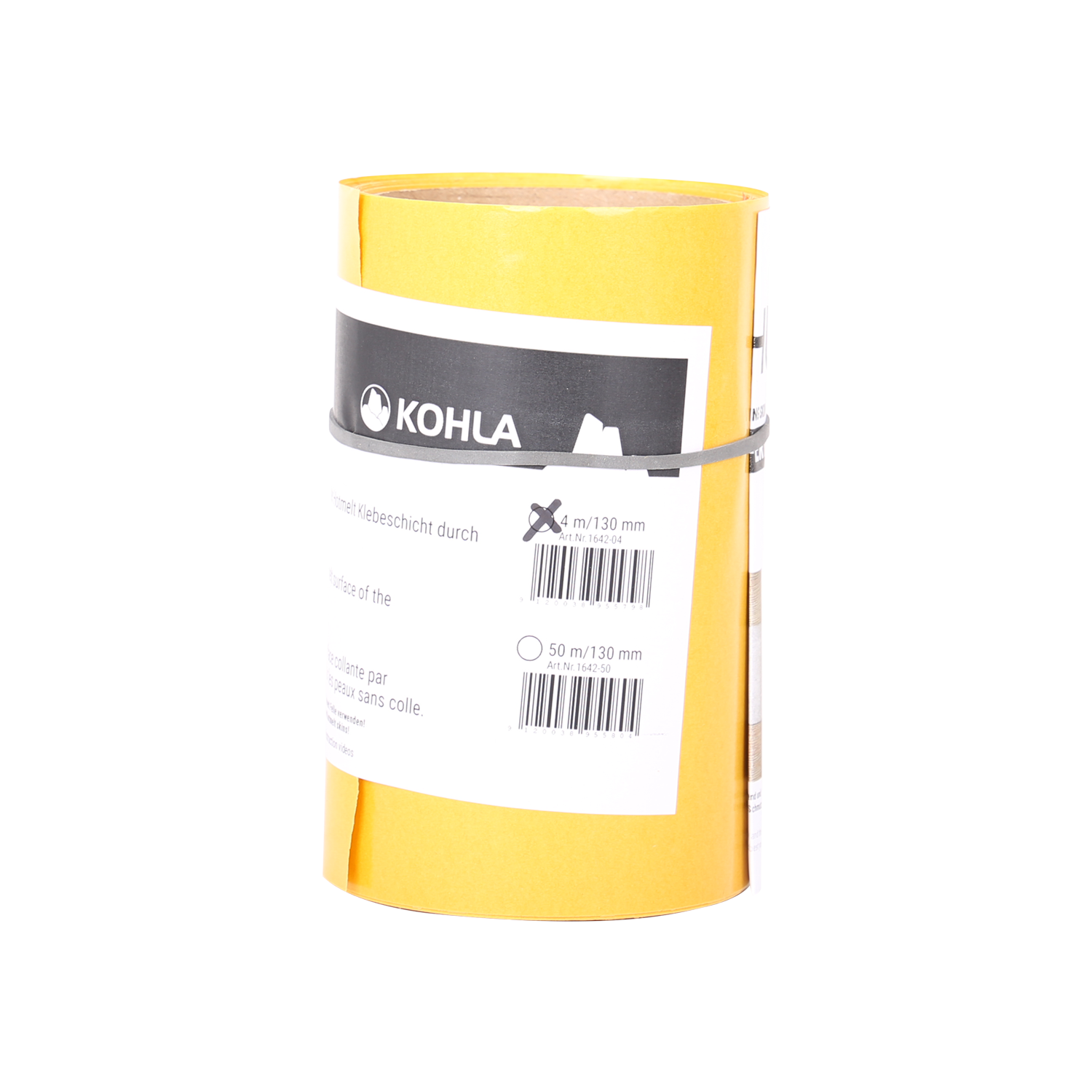
Before you start recoating, make sure you are using the right transfer tape. Kohla transfer tape for recoating is available in two versions. For all skins equipped with Smart Glue (Alpinist series, Vertical series, Freeride series, Race series), Smart Glue transfer tape must also be used! For all hot melt coated skins (Peak series, Basic series), be sure to use hot melt transfer tape!

1. Preparation
Now place the climbing skin on a flat surface and, as a precaution, put something underneath it (e.g., cardboard, tarpaulin, or newspaper).

2. Masking
Use the tape to mask off the front and tail mounts. This will prevent adhesive residue.

3. Secure
It is best to secure your fur to the table with a clamp. This will ensure that it does not slip while you are scraping it.

4. Remove old glue layer
Next, take the scraper and the heat gun. Start at the tail end and then slowly work your way towards the front end. Move the heat gun slowly back and forth over the fur. Follow with the scraper. Make sure you hold the scraper at a relatively sharp angle of approx. 30 degrees. Wipe off the excess adhesive on the scraper from time to time.

5. Applying the recoating tape
First, loosen the clamp and push your skin to one side. Now roll out the transfer tape in front of you with the adhesive side facing up. Then place your skin with the adhesive side on the tape.

6. Cutting the transfer tape to size
Now take your cutter and carefully cut around the contour of the skin. The transfer tape should end up having the same shape as your cut ski touring skin.

7. Ironing
Now iron on the transfer tape using an old iron (no steam!) or a special ski iron. Iron slowly from front to back at 160°C to 170°C three to four times, applying moderate pressure. Then leave the skin to cool, preferably overnight.

8. Check the glue layer
Carefully peel back a corner to check whether the adhesive is still sticky. If so, it is too early to remove the film. Wait a little longer until everything has cooled down completely.

9. Remove the backing film
Once everything has cooled down completely, the yellow film on the transfer tape can be removed. The adhesive has now transferred to the adhesive side of the climbing skin and the film can be carefully peeled off from front to back.
Using protective net correctly
Smart Glue technology:
With skins featuring Smart Glue technology, you can stick your skins together without using the release film. This is actually advantageous, as the adhesive technology is reinforced when the skins are stuck together again. We only recommend using a release film for storage over a longer period of time, e.g., over the summer, to protect the adhesive from drying out.
Hot melt technology:
A film is mandatory here! This is a very strong adhesive that can only be pulled apart again with considerable effort. For this reason, we recommend always using the release film.
Skin care
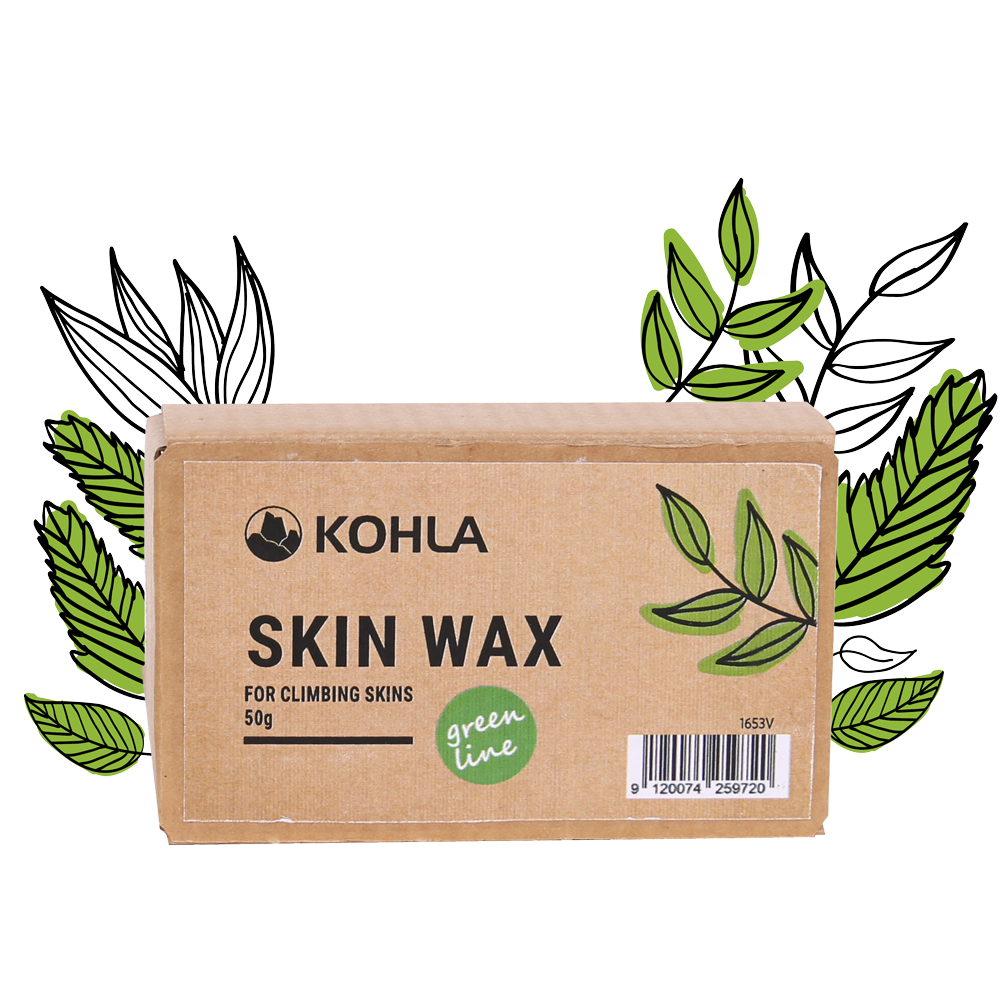
To prepare your skin optimally for your next tour, it is best to impregnate it directly with products from the KOHLA Green Line.